




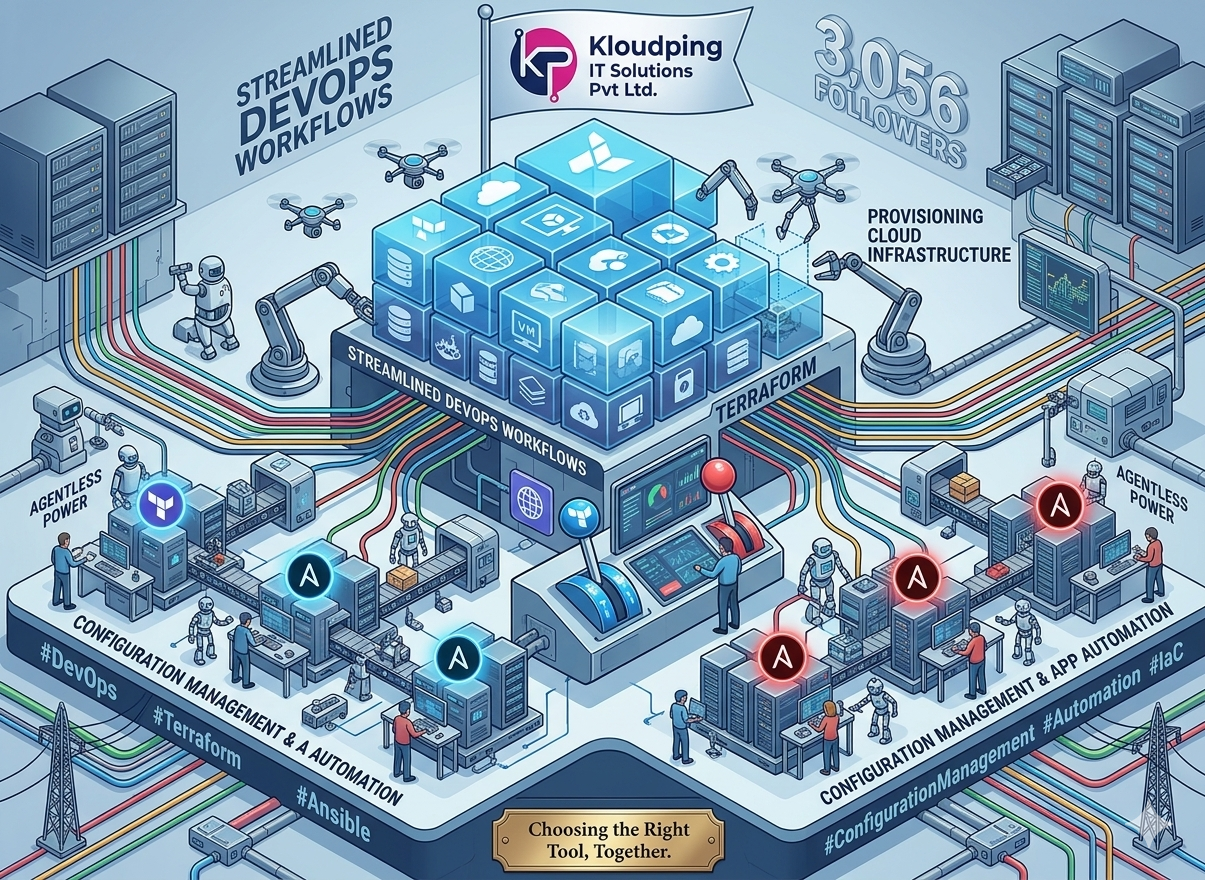






Many organizations view infrastructure tooling as a binary choice—forcing engineering teams to pick between different automation paradigms. A rapidly scaling financial technology client approached Kloudping IT Solutions struggling with disconnected operations. Their infrastructure provisioning was manual and sluggish, while their post-deployment application configurations were inconsistent across server fleets. Kloudping stepped in to break down this tooling silo, architecting an integrated DevOps workflow that combined the unique strengths of both Terraform and Ansible.
Bridging the Gap Between Server Provisioning and Application Readiness
The client’s operational pipeline was fractured at the server level. While their development teams wanted agile, multi-cloud infrastructure environments, they lacked a continuous management framework to handle internal software states, security patches, and application dependencies once those servers were live. Relying on separate teams or custom scripts to hand off newly built cloud services to software deployers created severe execution lag, human error, and inconsistent environments across their development cycles.
"Instead of forcing us to choose between orchestration and configuration, Kloudping integrated Terraform and Ansible seamlessly. Our entire pipeline—from cloud networks down to application settings—is now hands-free." — Head of DevOps, FinVantage Global
Multi-Layered Automation Strategy
Kloudping designed a seamless dual-tool pipeline. We deployed Terraform as the master orchestrator to build cloud services below the server level, and hooked it directly into Ansible to drive continual, agentless configuration management and application automation. Our strategy targeted three key execution layers:
- Cross-Provider Infrastructure Orchestration via Terraform
- Agentless, Real-Time Application Configuration Management with Ansible
- Streamlined Tool Handoff via Dynamic Asset Inventory Integration